robotic.icu:
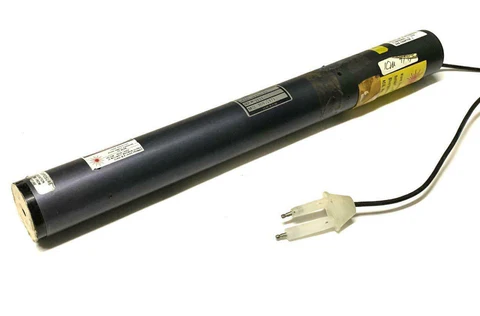
Hughs HENE laser model 3225H-PC
Posted in: News | by Robo Tron | 2025 Nov 04
Hughs HeNe
I have a Hughs HENE laser model 3225H-PC. 10mw Class III B. What is the power supply requirements for it?
The Hughes HENE laser model 3225H-PC, a 10 mW Class IIIb laser, requires a power supply with specific electrical characteristics to operate safely and effectively.
The operating voltage for this tube is expected to be in the range of approximately 2,300 to 2,800 VDC, based on the typical operating voltage for similar high-power HeNe lasers.
The required operating current is 7.0 mA, which is a standard value for 10 mW tubes.
The power supply must be capable of providing a starting voltage of 5 to 12 kV at almost no current to initiate the discharge.
For compatibility, the power supply should be a modern, fixed-current type designed for HeNe lasers. The Hughes 3225H-PC is compatible with the 5040/5040F power supply model, which outputs 7.0 mA at a voltage range of 2,600 to 2,800 VDC.
This supply is specifically listed as compatible with the 3225H-PC model.
The power supply should also be capable of accepting an input of 115 or 230 VAC.
A ballast resistor is essential for stable operation, as the HeNe tube is a negative resistance device, and the total resistance (power supply, ballast, and tube) must be greater than zero to prevent oscillation.
The ballast resistor may be included within the laser head assembly or be an external component.
The power supply must be connected with correct polarity: the positive output to the anode (via the ballast resistor) and the negative output to the cathode.
Incorrect polarity can cause significant damage to the tube.
Modern high-frequency switching power supplies are efficient and can accept a wide range of inputs, including 5 VDC to 240 VAC, making them versatile for various applications.
The power supply should be potted in thermally conductive material to manage heat, as the laser and ballast resistor dissipate most of the input power as heat.
For a male Alden connector with one long/wide prong and one short/narrow prong, the short/narrow prong is positive (+) and the long/wide prong is negative (–). This is the standard pinout for Alden connectors used with HeNe lasers, ensuring proper polarity when mating with the female receptacle.
If I build my own power supply, how far apart does the output leads inside the supply need to be?
For a homemade power supply for your Hughes 3225H-PC HeNe laser, the high-voltage output leads must be spaced to prevent arcing. Based on IPC-2221 standards, for operating voltages of 2,300–2,800 VDC, the minimum air gap (clearance) should be at least 2.5 mm, with an additional safety margin recommended.
Given the high starting voltage (5–12 kV), a spacing of 5–10 mm or more is prudent to handle voltage spikes and ensure safe, reliable operation. Use insulated wires rated for high voltage and keep leads short and well-separated.
Is it possible to make a 5 to 12v input boost converter, output the required voltage?
Yes, it is possible to build a boost converter that inputs 5–12 VDC and outputs the 2,300–2,800 VDC required for your Hughes 3225H-PC HeNe laser, with a starting pulse of 5–12 kV. However, it is complex and dangerous due to the high voltage and precise current regulation (7.0 mA) required.
Such a converter typically uses a DC-DC inverter with a flyback transformer and voltage multiplier (Cockcroft-Walton ladder) to achieve the high voltage. The circuit must include current limiting and stable regulation to avoid damaging the laser tube.
Given the risks and complexity, using a commercial or surplus HeNe power supply brick is strongly recommended over a DIY design.
Can the supply voltage be modulated to send data over the beam?
Yes, the power supply voltage of a HeNe laser like your Hughes 3225H-PC can be modulated to send data or audio over the beam. This is typically done by superimposing an audio or data signal onto the high-voltage supply, which varies the tube's light output intensity (AM modulation).
Common methods include:
Modulating the low-voltage input (e.g., 12 V) of a switching power supply using a 555 timer or audio signal.
Inserting an audio transformer in series with the high-voltage output for isolation and modulation, even with encapsulated supplies.
The laser must operate in its linear range to avoid distortion, and the modulation frequency should be well below the power supply’s switching frequency (often 15–50 kHz), with audio signals typically limited to 300–3,000 Hz.
Are there inexpensive supplies with output modulation capabilities?
Yes, inexpensive HeNe power supplies with modulation capability are available, though often used or surplus. Many commercial units, such as those from Power Technology (HCU series), include a modulation input for audio or data transmission via the laser beam. While new compatible supplies exist, used Melles Griot, Uniphase, or Hughes units on eBay or surplus sites are often the most affordable options—typically $50–$150.
Look for models labeled “modulated” or with a separate low-voltage input (e.g., 1–5 V or 0–3 V) for analog intensity modulation. Some even accept TTL signals for digital modulation.